
Edo Period
Bakufu Encouraged Drugs
Drugs were initially sold widely around the middle of the Edo period when the Bakufu (military government of Japan headed by the shogun) encouraged drug production and sales to help improve the health of citizens. As drug production grew up and distribution efforts gained momentum, the merchants who dealt in drug ingredients grew in power. The Bakufu awarded special monopoly rights to those who paid a special tax. There were 24 publicly approved drug wholesaler unions in the Honcho neighborhood of Edo (present-day Tokyo), and 124 drug traders in the Doshomachi neighborhood of Osaka.
Drug Wholesalers(Oroshi) Contributed to the Quality Assurance of Traditional Japanese Medicines
There were two types of drugs: (1) Tang drugs imported to Japan by China in the production areas, and (2) Japanese drugs produced in Japan. Since all of the Tang drugs followed a single distribution course from the Tang drug wholesalers in Osaka to the drug traders of Doshomachi to drug wholesalers nationwide, drug quality was reasonably reliable. Japanese drugs, however, did not follow any established distribution channels, facilitating the frequent appearance of counterfeits. The Bakufu established Wayaku Aratame Kaisho (evaluation institutes for Japanese traditional medicines) in the five cities of Edo, Sunpu, Kyoto, Osaka, and Sakai, and created a system whereby all drugs had to be examined by a Kaisho before they could be sold. The drug wholesalers played an important role in ensuring a stable supply of drugs and providing a quality assurance function.
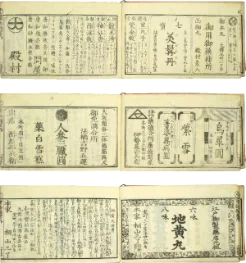
Drug Wholesalers
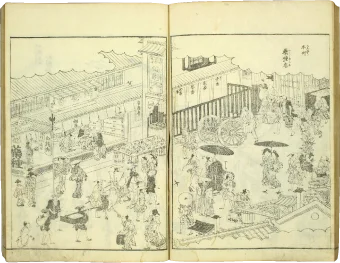
Drug advertisements of Edo
- Image archive: Waseda University Library
- Reference materials: Doshomachi, a Town of Drugs (Doshomachi Resource Preservation Society)
- 55 Years of the Drug Wholesaling Industry (Federation of Japan Pharmaceutical Wholesalers Association)
- History of Clinical Drugs (Hiroshi Amano, Yakuji Nippo)
- Druggists of Edo (Shin Yoshioka, Seiabo)